Immediate help for seasickness
The artificial horizon
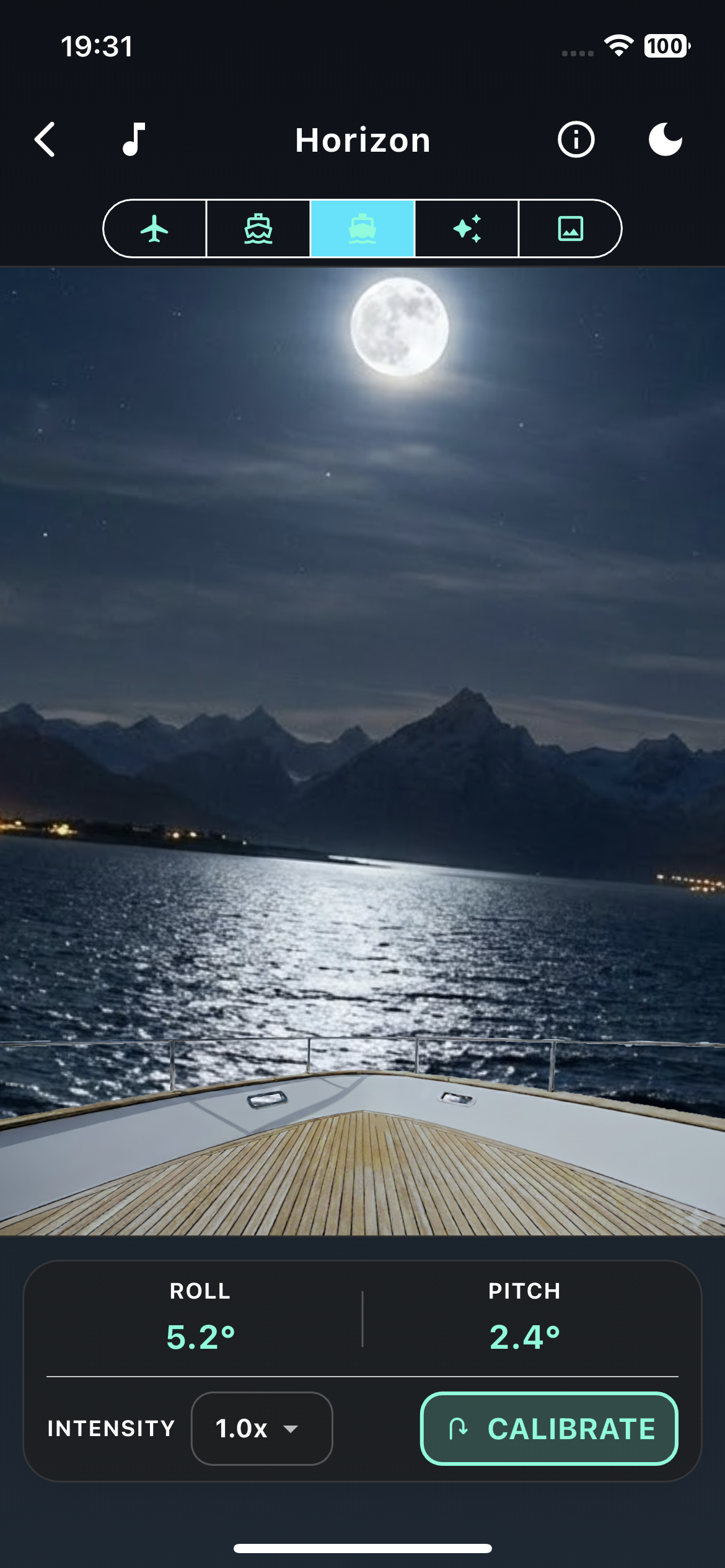
Seasickness is caused by a sensory conflict: The eye reports a standstill – for example in the windowless inner cabin of a ship – while the balance organ simultaneously senses the movement. Some ship travelers currently manage below deck with a half-filled water bottle on the table to make the ship's movement visible to the eye again. The artificial horizon in the app is essentially the modern, digital translation of this principle directly on the screen. It gently balances the conflict by making real movement synchronously visible. Use this method ideally on the ship below deck.
Why this helps: The display of an earth-referenced line provides the brain with the missing visual movement information back. On the screen, you see the bow of a ship and the sea with a mountain range on the horizon. While the bow remains rigid, the background image tilts exactly synchronously to the actual swaying based on the sensor data of your smartphone. Your brain thus gets the missing visual confirmation of the movement back, which gently relieves the queasy feeling in the stomach.
Read article
Scientific Background & Sources
Background: The display of an earth-referenced line provides the brain with the missing visual movement information (inertial cues). This resolves the sensory conflict and prevents the error message in the brain that leads to travel discomfort.
Sources:
- Bos, J. E., et al. (2005/2012). TNO Human Factors / Vrije Universiteit.
Calming for nausea, flight anxiety, inner restlessness, or feelings of panic
Situational Breathing Techniques
Find your inner balance again. Whether your stomach gets queasy on winding roads, you are nervous while boarding the plane, or you feel a sudden wave of panic – your breath is your strongest anchor. Viativity offers you four targeted rhythms in the "Breathing Techniques" tool, which are matched exactly to your current state.
Gentle haptic vibrations guide you blindly through the rhythm. So you can close your eyes and concentrate entirely on your relaxation:
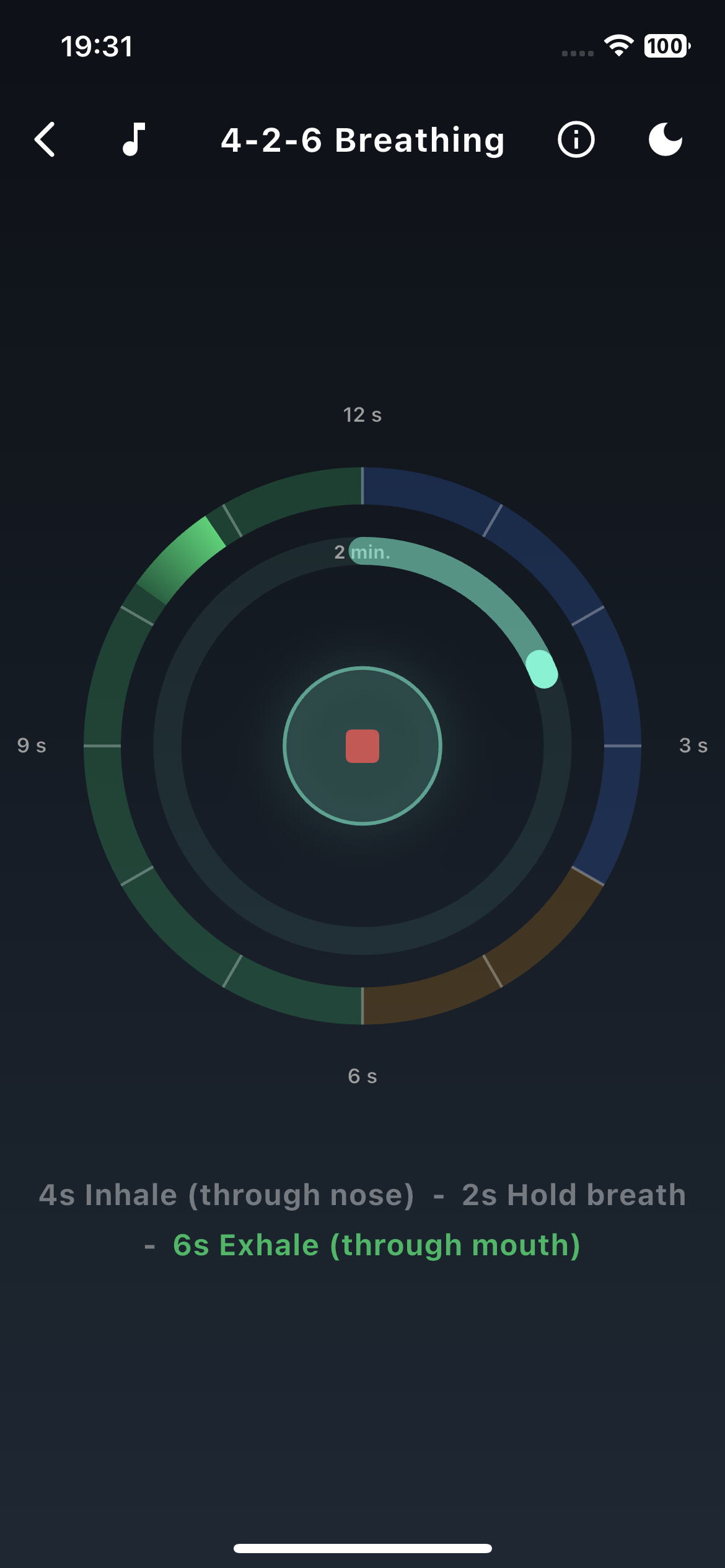
- For nausea (4-2-6 rhythm): Inhale for 4 seconds, hold for 2 seconds, exhale for 6 seconds. Gently calms the stomach and circulation and relieves the queasy feeling in the stomach.
- For flight anxiety (4-7-8 rhythm): Inhale for 4 seconds, hold for 7 seconds, exhale for 8 seconds. The extra-long exhalation helps you to consciously find calm during flight anxiety or tension in the airplane.
- For inner restlessness (4-4-4-4 Box Breathing): Evenly inhale, hold, exhale, and hold empty for 4 seconds each. Relieves stress without making you tired.
- For feelings of panic (3-1-8 Physiological Sigh): Inhale for 3 seconds and fill your lungs to 70%, inhale again for 1 second and fill your lungs completely, exhale with an audible sigh for 8 seconds. Supports the short-term regulation of stress and tension.
Why this helps: Consciously controlling and prolonging your exhalation specifically activates your body's resting nerve. This gently dials down stress reactions, signals relaxation to the brain, and noticeably dampens the urge to vomit while traveling.
Scientific Background & Sources
Background: Controlled, slowed breathing (Paced Breathing) stimulates the vagus nerve and increases heart rate variability (HRV). This significantly dampens physical arousal and has proven effective for accompanying restless travel as well as in stressful situations.
Sources:
- Stromberg, S. E., et al. (2015). Diaphragmatic breathing and its effectiveness for the management of motion sickness. Aerospace Medicine and Human Performance.
- Vierra, J., et al. (2022). Effects of sleep deprivation and 4-7-8 breathing control on heart rate variability, blood pressure, blood glucose, and endothelial function in healthy young adults. Physiological Reports.
- Balban, M. Y., et al. (2023). Brief structured respiration practices enhance mood and reduce physiological arousal. Cell Reports Medicine.
Relaxation through sound
Audio Methods & Frequencies
Use the power of sound for more inner peace. Whether your stomach rebels on rough seas, you feel tense when flying, or you simply can't switch off in your hotel room – your hearing offers a wonderful gateway to relaxation. Viativity offers you four scientifically based audio frequencies that are matched to your current state. Simply put on your headphones and choose the right sound:
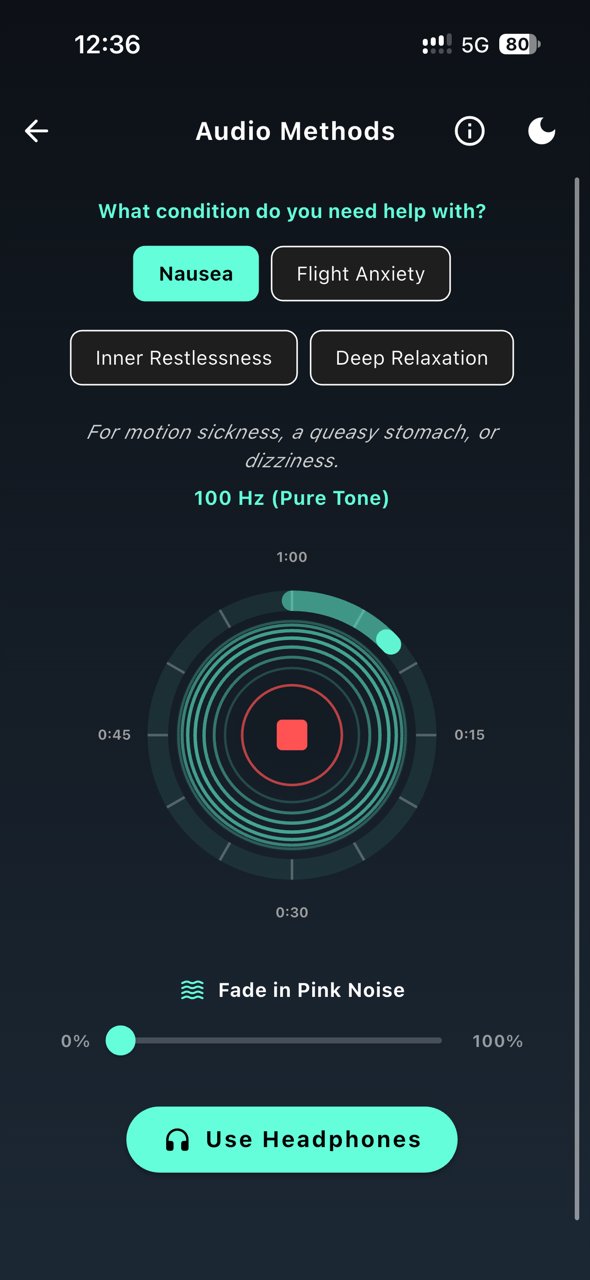
- For nausea (100 Hz): A deep, pure tone that serves as a focusing companion. It helps to gently reduce conflicting movement stimuli. (Simple mono headphones are sufficient for this).
- For flight anxiety (6 Hz): A calming stereo effect that stimulates the natural relaxation rhythms of your brain. Supports you in consciously finding peace and serenity during acute tension.
- For inner restlessness (16 Hz): Ideal for sensory overload at train stations or airports. Aims to gently stimulate the resting nerve and ensures a relaxed wakefulness without making you tired.
- For deep relaxation (1 Hz): An extremely slow rhythm that corresponds to the deepest resting state of your brain. Gently guides your body into relaxation and supports switching off and falling asleep in an unfamiliar environment.
Why this helps: The brain has the ability to adapt to acoustic rhythms (Frequency Following Response). Slow, steady rhythms via headphones gently slow down brain activity. This signals safety to the body, dials down the state of alarm, and noticeably supports relaxation.
Scientific Background & Sources
Background: At 100 Hz, a recent study on the stimulation of the sense of balance (vestibular stimulation) serves as the basis for the acoustic accompaniment. The frequencies 6 Hz, 16 Hz, and 1 Hz use a special stereo effect where the brain itself creates a calming rhythm from two tones (binaural beats) to guide the brain into defined states of relaxation (theta, alpha, and delta waves) through acoustic impulses (auditory stimulation / entrainment).
Sources:
- Gu, Z., Kagawa, T., Kato, M. et al. (2025). Vestibular stimulation by 100-Hz vibration suppresses motion sickness. Applied Ergonomics.
- Wiwatwongwana, D. et al. (2024); Garcia-Argibay, S. et al. (2019). Efficacy of binaural auditory beats in cognition, anxiety, and pain perception: a meta-analysis. Psychological Research.
- Padmanabhan, R. et al. (2005). A prospective, randomised, controlled study examining binaural beat audio and pre-operative anxiety. Anaesthesia.
- Kim et al. (2026); McConnell et al. Sedative effects of delta-frequency binaural beats.
Preventive Training for the Journey
Visual Training
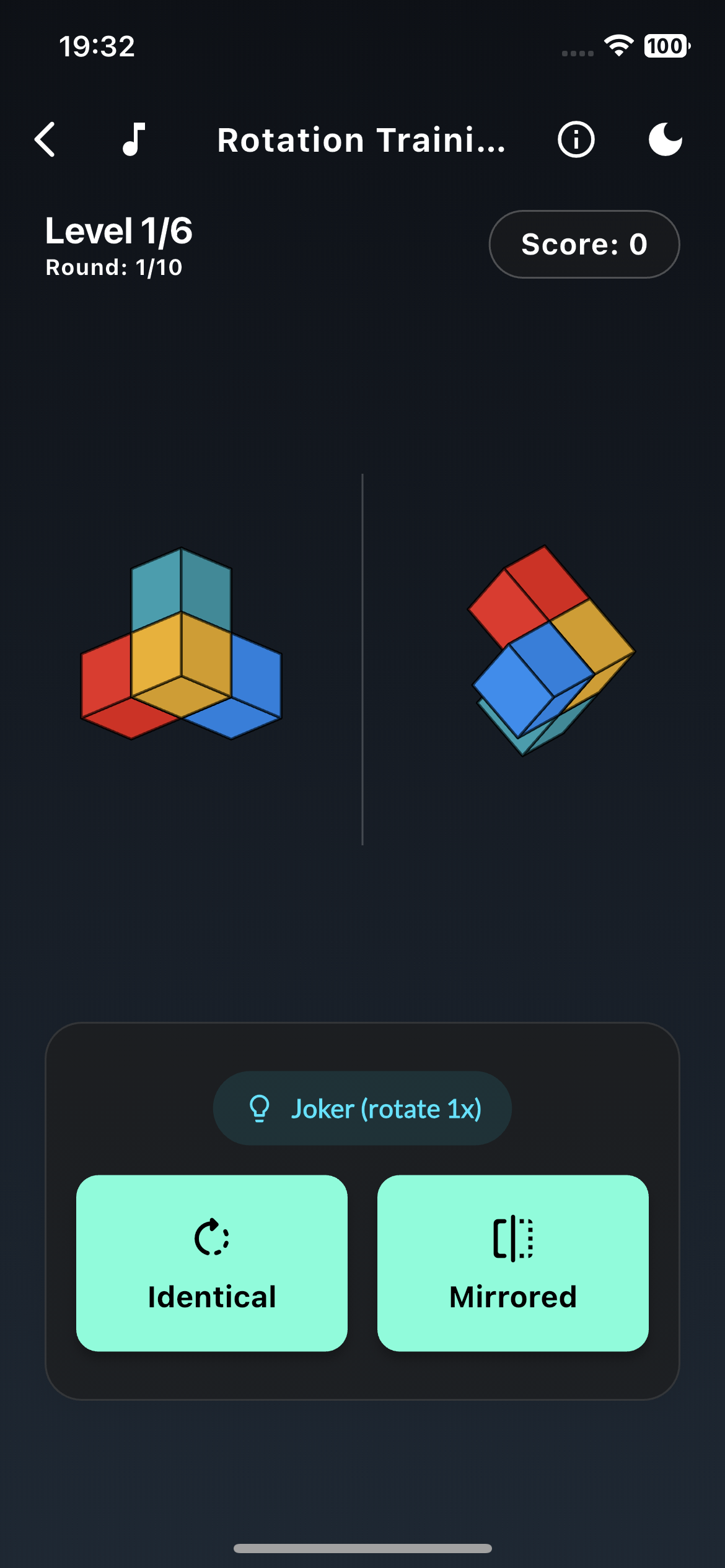
Prepare yourself weeks before the vacation so that the trip to your destination starts relaxed. A trained spatial imagination helps the brain process spatial and movement data more efficiently on the journey. IMPORTANT: This is purely preventive training. Practice daily for about 15 minutes in peace before the trip. Application: Decide in the interactive game whether the right 3D figure is identical (just rotated) or mirrored. You have one joker per level.
Why this helps: Such spatial visual training trains the brain to resolve conflicting signals and movements much faster. This can significantly reduce individual susceptibility to travel discomfort in advance.
Scientific Background & Sources
Background: A study reported a reduction of kinetosis symptoms in a simulator by up to 51% after a 14-day spatial visual training (visuospatial training). Viativity offers you a similar exercise to playfully train your spatial perception.
Sources:
- Smyth, J., et al. (2021). Visuospatial training improves driving performance and reduces motion sickness. Applied Ergonomics.